Defining the District Town Planner Role
Primary Mission and Core Purpose
A district town planner is the municipal official responsible for shaping how land within a specific district is used and developed. Their primary mission is to balance growth with sustainability, ensuring that housing, commerce, and public spaces coexist effectively. This role demands more than just map reading; it requires negotiating between developers, residents, and local government.
The core purpose centres on guiding development in a way that serves the public interest. They assess zoning applications, enforce land use policies, and plan for future infrastructure needs. In South Africa, this position also involves addressing spatial inequality left by apartheid-era planning. Anyone asking who is district town planner will find a professional who sits at the intersection of policy, design, and community needs.
- Reviewing development proposals against municipal regulations
- Consulting communities on proposed projects
- Recommending policy changes to council
This role is not about drawing lines on maps. It is about translating planning law into practical, livable spaces that serve residents today and in the decades ahead.
Position in the Local Government Structure
If you have ever sat through a council meeting and wondered who is district town planner, look for the person taking notes near the back. That official holds a middle management position inside the planning department. They report to the director of development services, who answers to the municipal manager. Their district covers a large town or a cluster of small municipalities sharing one planning office.
The role sits between authority and ground level. The planner receives direction from councillors and provincial policy makers, then translates it into street level decisions. They interact with ward councillors, provincial auditors, and public works teams.
For anyone asking who is district town planner, this person manages the council’s decisions at street level. They check that documents go to the right teams, objections get written down, and construction matches the approved scheme. The job only exists because policy has to take physical shape somewhere.
Differences from City and Regional Planners
The district town planner does not fit into a single definition. A city planner in Johannesburg works within one dense urban boundary. A regional planner might chart growth corridors across three provinces. The district town planner, however, operates in the territory between those positions. Their area often includes a central town plus scattered rural nodes, each with its own infrastructure limits.
For anyone asking who is district town planner, the practical distinctions are useful:
- City planners regulate high-rise density and inner-city transport.
- Regional planners map broad land-use frameworks and environmental constraints.
- District town planners reconcile those frameworks with local ward-level realities.
The work demands temporal awareness as well. City plans adjust yearly. Regional plans span decades. District plans shift with municipal budgets and seasonal pressures. Their authority flows directly from the Spatial Planning and Land Use Management Act, but the everyday job is about coordination, not command.
Core Responsibilities and Work Areas
Land Use Planning and Zoning Regulation
Zoning regulations determine whether a spaza shop can operate next to a primary school. This is where the question of who is district town planner becomes critical. These professionals manage land use planning through enforceable frameworks, not abstract preferences. Their responsibilities stretch across several specific work areas:
- Reviewing rezoning and departure applications against municipal spatial development frameworks
- Conducting site inspections to verify compliance with approved land use rights
- Preparing reports for appeals boards and provincial planning tribunals
To understand who is district town planner, you must watch them interpret zoning schemes in real time. They mediate between developers, neighbours, and municipal bylaws. Every recommendation carries weight, and zoning regulation demands both technical precision and practical judgement.
Reviewing Development Applications and Permits
Every development application that lands on a municipal desk passes through the district town planner’s review first. They compare the proposed use against the zoning certificate, the building plans, and the municipal spatial development framework. This is the moment where who is district town planner moves from job title to actual function.
The review involves several checks:
- Confirming the erf description and title deed conditions
- Assessing the impact on surrounding land uses and traffic flow
- Flagging applications that require public participation or environmental authorisation
- Recommending conditions of approval to the municipal planning committee
Permits receive the same scrutiny. A temporary trading permit for a container shop, a consent use for a home business, or an occupancy certificate all cross the same desk. The planner corresponds directly with applicants, engineers, and conveyancers, closing gaps before the application reaches the statutory decision maker.
Community Consultation and Public Engagement
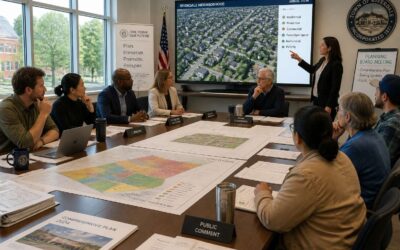
The district town planner does not operate in isolation. Community consultation forms a critical part of the role, especially when a proposal triggers public interest or environmental concerns. Before any recommendation is made, the planner must gauge local sentiment, address objections, and sometimes adjust conditions based on resident feedback. This engagement often happens through formal comment periods, public meetings, or written submissions.
For many applicants, this stage feels like a mystery. Yet the process is straightforward when you understand the planner’s duty. They must balance private development rights with the broader public good.
– Clarifying procedural steps for nervous applicants
– Summarising technical reports for lay audiences
– Recording and responding to formal objections
– Recommending mitigation measures after public input
Ultimately, the question of who is district town planner extends beyond permits. It is someone who translates civic voices into practical planning outcomes. That translation work, done well, prevents disputes and builds trust in the system. Every comment received, every concern logged, shapes the final decision forwarded to the committee. The planner listens, filters, and advises, ensuring the public interest is never an afterthought.
Environmental and Sustainability Strategy
Environmental resilience rests on decisions made years before construction begins. The district town planner evaluates ecological constraints, water availability, and climate risk before any layout gains approval. This work extends beyond preserving green belts. It directs growth away from floodlines, protects agricultural corridors, and secures servitude space for future infrastructure.
Sustainability strategy requires long-term thinking. The planner assesses stormwater run-off, energy demand, and waste integration for each proposal. Key checks include:
1. Floodline mapping and buffer determination
2. Wetland and heritage impact screening
3. Water supply and sanitation capacity
4. Climate adaptation measures
In South Africa, where municipal capacity varies, the planner aligns provincial environmental legislation with local realities. Understanding who is district town planner now includes this environmental gatekeeping role. Every recommendation carries an ecological footprint.
Growth Forecasting and Infrastructure Coordination
Growth forecasting is a strange craft. To understand who is district town planner, watch how they read population curves, economic signals, and migration patterns to predict where development will land before it happens. In South Africa, this means tracking urbanisation toward secondary cities and rural towns, not just the metros.
Infrastructure coordination then turns that forecast into reality. The planner matches projected density with road capacity, water pressure, electricity load, and public transport routes. Every approval carries a hidden timestamp. The goal is to ensure future residents never feel the strain.
Coordination points include:
- Servitude alignment between municipalities
- Phasing bulk infrastructure with housing delivery
- Transport integration beyond city borders
So, who is district town planner? In this light, a forecaster and infrastructure broker who prevents the slow collapse of urban systems. Ask this question again after the next census, and the answer shifts with every new township.
Educational and Professional Requirements
Typical Academic Degrees and Specializations
To grasp who is district town planner, start with their academic pedigree. In South Africa, a Bachelor’s degree in Town and Regional Planning, accredited by the South African Council for Planners (SACPLAN), forms the baseline. Some aspirants hold degrees in geography, civil engineering, or public administration, then pursue a postgraduate diploma in urban planning. Either path demands rigorous coursework in land economics, statutory frameworks, and spatial analysis. As they progress, district town planners often narrow their focus into specific domains, including:
- Land use management systems
- Strategic environmental assessment
- Housing and settlement planning
- Infrastructure corridor planning
Professional registration follows a period of mentored practice, typically two to three years. From my experience, this phase separates those who truly understand municipal systems from those who merely memorize policies. Candidates then pass SACPLAN’s professional examination. These specializations directly influence how a planner interprets development proposals and shapes settlement patterns.
Certifications and Professional Body Membership
The Planning Profession Act 36 of 2002 draws a legal line around who may call themselves a planner. For anyone asking who is district town planner under South African law, registration with SACPLAN is non-negotiable. The title is reserved.
The path runs through Candidate Planner status, followed by two to three years of logged professional practice. My own candidacy year taught me how rigorous the oversight is. A panel audits each submitted project for technical depth, and passing the Professional Practice Examination is mandatory.
Certification remains an ongoing matter. Annual Continuing Professional Development points are audited, with the minimum tracked by SACPLAN.
The registration requirements include:
- A verified portfolio of practical work
- A mentorship report from a registered planner
- A clean disciplinary record
- Paid annual fees
Voluntary membership in the South African Planning Institute adds a further layer of professional credibility. When residents ask who is district town planner, the SACPLAN register offers the definitive answer.
Hands-On Experience and Internship Pathways
Before anyone can answer who is district town planner, they must understand the apprenticeship that shapes such a professional. The academic degree is only the foundation. What follows is a structured terrain of practical exposure, where theory meets the gritty realities of municipal administration.
Internship pathways in South Africa typically unfold through:
- Provincial and municipal planning departments, where candidates process real applications under supervision
- Private consulting firms offering mentorship contracts
- Development agencies focusing on housing and infrastructure projects
Each placement demands a minimum of two years of logged work. This period builds the judgment required for statutory decision making. The question of who is district town planner becomes clearer once you see the portfolio of resolved disputes and approved schemes they carry forward.
Continuing Education and Emerging Specialties
Ask again five years from now, and the answer will shift. The question of who is district town planner mutates as fast as the municipalities it serves. Continuing education is not optional; it is the mechanism that keeps decisions legally defensible. Planners accumulate CPD points and short-course credits, or their competence fades.
- Climate adaptation and sea-level rise mapping
- Data-driven spatial analytics and GIS modeling
- Informal settlement upgrading and resilience planning
Each demands new technical fluency. I watch practitioners return to university lecture halls, chasing these frontiers. The honest answer today is a professional who studies ceaselessly, trying to master what comes next!
Essential Skills and Competencies
Technical and Legal Knowledge Base
To answer who is district town planner, one must examine the intersection of law and technical craft. In South Africa, this professional navigates SPLUMA, the National Environmental Management Act, and local zoning schemes, each with procedural nuances. Legal fluency is essential. A single misstep in public participation timelines can invalidate an entire application.
Technical competence runs parallel. Geographic information systems, cadastral databases, and hydrological models form the planner’s toolkit. These tools translate raw data into land use decisions. They reveal flood lines, wetland boundaries, and service corridors that shape every recommendation. Without this technical grounding, legal compliance becomes guesswork.
Communication and Civic Facilitation
Understanding who is district town planner requires looking beyond regulations. This professional must translate zoning maps and environmental impact reports into language a community can act upon. Public meetings become arenas of negotiation. A planner who misreads public sentiment will fail, regardless of technical prowess.
Civic facilitation demands patience. Residents arrive with fears about property values, traffic, and noise. The planner listens, then guides the discussion toward evidence. This requires structured engagement.
- Active listening to identify hidden concerns
- Conflict resolution when stakeholders clash
- Adapting presentations for varied literacy levels
Every conversation builds or erodes trust. The district town planner who masters this craft turns opposition into collaboration, shaping outcomes that survive legal scrutiny.
Critical Analysis and Problem Solving
In his 1969 book The Image of the City, Kevin Lynch argued that urban environments shape our mental maps. For the district town planner, this cognitive burden is reversed. They must read a chaotic landscape and separate signal from noise. Critical analysis here is forensic. It involves dissecting a development proposal to find the hidden fault lines, the contradictions between stated intent and probable outcome. This is where the answer to who is district town planner becomes clear: a professional who treats every application as a hypothesis requiring rigorous testing.
Problem solving for the district town planner means working within constraints that are often invisible to the public. Infrastructure limitations, environmental sensitivities, and financial realities collide on a single piece of land. The planner must synthesize these pressures into a coherent position. It is an exercise in applied logic, where emotion is set aside in favour of measurable impact. The synthesis process requires a specific mental toolkit:
– Weighing competing data sets to determine net community benefit
– Identifying secondary effects of a decision, such as strain on stormwater systems or school capacity
– Forecasting long term maintenance costs versus short term development gains
The true test arises when data points conflict. A new housing estate might relieve density pressures but place untenable stress on an aging sewer network. The planner does not freeze. They seek a third option, whether that means negotiating a revised layout or recommending a phasing strategy. This pragmatic flexibility is rare. Many possess the technical knowledge, but few can wield it under pressure. When I examine a file, the question is never whether a solution exists. It is whether the proposed solution holds up under the weight of future variables. This analytical integrity is the core of the role. Without it, the district town planner is merely a clerk, processing paperwork instead of shaping places. The job demands a stubborn commitment to evidence, even when the evidence complicates the path forward.
Leadership and Cross-Departmental Collaboration
Leadership in this role rarely announces itself with a title. It emerges in corridors and shared meeting rooms. I have watched capable planners persuade engineers, finance officers, and environmental health practitioners to align behind a single spatial vision. Each department speaks its own technical dialect. The planner translates.
Consider the municipal budget cycle. Without early collaboration, spatial plans arrive too late for funding allocation. The result is an unfunded mandate.
A capable planner builds these relationships before crisis demands them. They understand:
- Who owns the stormwater masterplan
- Which official signs off on environmental authorisations
- How the housing department sequences its projects
This clarity prevents gridlock! It also answers a practical question: who is district town planner? Someone who coordinates decisions across silos, not merely a mapmaker.
Project Management and Resource Prioritization
Project management in this role resembles conducting a perpetual triage. Every spatial proposal competes for finite staff hours, technical studies, and political goodwill. The district town planner decides which initiatives proceed and which wait.
Resource prioritization demands honest assessment. A housing project might deserve urgency, but if the environmental impact assessment lacks funding, the timeline collapses. The planner sequences work so that dependencies align.
- Mapping critical path activities across financial years
- Identifying which projects unlock external funding
- Tracking progress against statutory deadlines
This practical discipline defines who is district town planner. The role belongs to a manager of scarce public resources.
Career Outlook and Professional Impact
Typical Career Progression and Mobility
According to the South African Council for Planners, employment for district town planners has shown consistent resilience despite municipal budget pressures. This role offers a career path where every decision reconfigure uses of public land. Typical progression begins with an assistant planner position, then advances to a district portfolio after roughly five years of exposure to development applications. Mobility remains strong, as competencies transfer across metros, district municipalities, and rural councils.
Career growth depends on mastering complex approval pipelines and nurturing cross-departmental trust. A common trajectory looks like this:
- Junior planner in a local authority
- Senior development officer with zoning expertise
- District town planner overseeing multiple precincts
From that point, professionals often redirect into private consultancies or provincial planning departments. The professional impact is tangible. Decisions alter property values, infrastructure timing, and household access to services. Someone who is district town planner carries responsibilities that few local government roles replicate. The work stays intellectually rigorous, while delivering visible results for communities across South Africa.
Compensation Range and Employment Conditions
Career outlook for this post is anchored in legislation, not economic sentiment. Municipalities cannot defer statutory decisions on development applications, so understanding who is district town planner becomes a matter of operational necessity. Demand barely fluctuates, and each decision reshapes infrastructure timing and household access to services, giving the work measurable civic weight.
Compensation reflects that permanence. Typical packages include:
- pension and medical aid subsidies
- a 13th cheque or performance bonus
- paid professional registration fees
Annual salaries range from roughly R720,000 to R1.1 million, depending on municipal category and seniority. The post is predominantly office based, though site inspections are routine. I have seen councils offer extra leave for this role, a sign of how hard it is to replace.
Contribution to Sustainable Community Building
Ask any municipal manager and they will tell you: the district town planner is the central figure behind habitable neighbourhoods. Career outlook here is anchored in legislation, not market whims. Because municipalities must process development applications, the role persists through economic dips and booms alike.
Professional impact shows up in tangible ways. Each zoning decision influences water runoff, energy use, and public space. When you understand who is district town planner, you see someone who shapes sustainability at street level. They balance density with green corridors, ensuring future residents inherit functional towns.
For those entering the field, the work offers civic weight. You are not pushing paper; you are managing growth. That permanence attracts people who value long term outcomes over quick wins.
Key Challenges and Practical Strategies
Somewhere between the municipal corridors of power and the neat lines on a zoning map, ambition often goes to die quietly. But the career outlook for this role remains remarkably resilient. The reason is simple. As long as development applications exist, someone must wrestle with them. The professional impact is direct. When you answer who is district town planner, you describe a gatekeeper of the built environment. Growth must fit the legislative grid. The land must be used efficiently. Every decision carries weight. The work is a permanent feature of local governance. It does not blink when the economy stumbles.
The role offers a peculiar kind of stability. Even when the private sector sheds jobs, the machinery of local government keeps turning. Yet the daily reality includes friction. Public hearings can turn hostile. Residents resent density. Developers demand speed. Councils sometimes ignore technical advice. The genuine challenge is managing these competing pressures without losing your professional compass.
Practical strategies for survival in this role include:
1. Document every recommendation clearly to protect against political fallout.
2. Master the municipal appeal process. You will use it often.
3. Build a rapport with engineers early. They will save you from costly errors.
4. Maintain a thick skin for public meetings. The loudest voices are rarely the majority.
The realistic view of who is district town planner involves constant negotiation. You learn to say no without shouting. You explain statutory limits to people who dislike limits. The work is not glamorous, but the permanence is real. Communities get built, watered, and powered under your watch. The impatience of the market meets the patience of the process. That clash defines the job. Professionals who accept this tension tend to last. Those who seek applause do not.
Long-Term Rewards and Civic Fulfillment
In South Africa, where municipal boundaries shift with the tides of political change, the question of who is district town planner carries a surprising answer for many: a long term custodian. The career outlook for this position is not tied to the boom and bust cycles of the private property market. It is anchored to the statutory obligations of the state. Every new housing project in Gauteng or the Western Cape requires a statutory eye. Every land use application needs a professional signature. This creates a durable demand that survives economic downturns.
The professional impact of this role extends far beyond the office. A district town planner shapes the physical legacy of a community. The roads you drive on, the placement of schools, and the buffer zones between industry and homes all trace back to a planner’s recommendation. This is a civic duty with a tangible footprint. For professionals who value seeing the result of their labour in the physical world, this role delivers a deep sense of accomplishment. The work is measured in decades, not quarters.
Long term rewards in this field are often intangible. Financial compensation is stable, but the real currency is the trust of the community. When a development is approved that creates jobs without destroying a wetland, that is a quiet victory. When a housing project is correctly denied because the land is flood prone, that is a silent save. The civic fulfillment comes from knowing you prevented a disaster or enabled a benefit that no one will ever attribute to you by name. That is the nature of the job.
A clear view of the rewards includes:
1. A consistent employment track record within local government structures.
2. The ability to influence the quality of life for thousands of residents.
3. A professional reputation built on fairness and legal precision.
4. The satisfaction of watching a township mature according to a logical plan.
The question of who is district town planner is often answered by looking at the results. A well managed district has efficient transport routes and coherent land use. That is the professional’s signature. The role offers a rare combination of administrative rigour and long term civic contribution. It is not a job for those seeking applause, but it is a career for those seeking permanence and purpose. The legacy is written in the landscape itself, a permanent record of professional dedication.


0 Comments